2026-10-29 ASRock Industrial AI BOX-A395 Brings Real-Time Edge AI to Flood Monitoring at Taiwan's Yuanshanzi Flood Diversion Channel
Background
Taiwan’s Yuanshanzi Flood Diversion Channel plays a critical role in protecting downstream communities along the Keelung River by diverting excess river water to the sea. Constructed following the severe flooding caused by Typhoon Nari in 2001, the channel can divert up to 1,310 cubic meters of water per second. During heavy rainfall and typhoons, timely recognition of changing water conditions is essential for effective flood monitoring and emergency response. Traditional CCTV-based water monitoring relies heavily on personnel to review live footage, interpret changing conditions, and determine when alerts are needed. As camera networks expand and video volumes increase, manual monitoring becomes more demanding, while centralized video processing faces growing pressure from concurrent video streams, AI workloads, and network transmission requirements.
To address these challenges, ASRock Industrial collaborated with Focus Intelligence Technology (FIT) to deploy an edge AI-powered water monitoring solution at the Yuanshanzi Flood Diversion Channel. Combining ASRock Industrial’s AI BOX-A395 edge AI computing platform with FIT’s smart water monitoring and system integration capabilities, the solution brings AI-powered image analysis closer to video sources while retaining the existing centralized water management infrastructure. Powered by the AMD Ryzen™ AI Max+ 395 processor, AI BOX-A395 delivers up to 126 TOPS of overall AI performance and supports up to 128GB of unified memory. The joint proof of concept (PoC) demonstrated a shift from minute-level recognition to second-level processing, helping accelerate the identification of changing water conditions and supporting more timely event notifications.
Challenge
The existing water monitoring architecture provides centralized visibility across cameras installed along rivers, at flood diversion facilities, on roads, and at other critical locations. However, as monitoring demands grow, the traditional workflow faces several limitations:
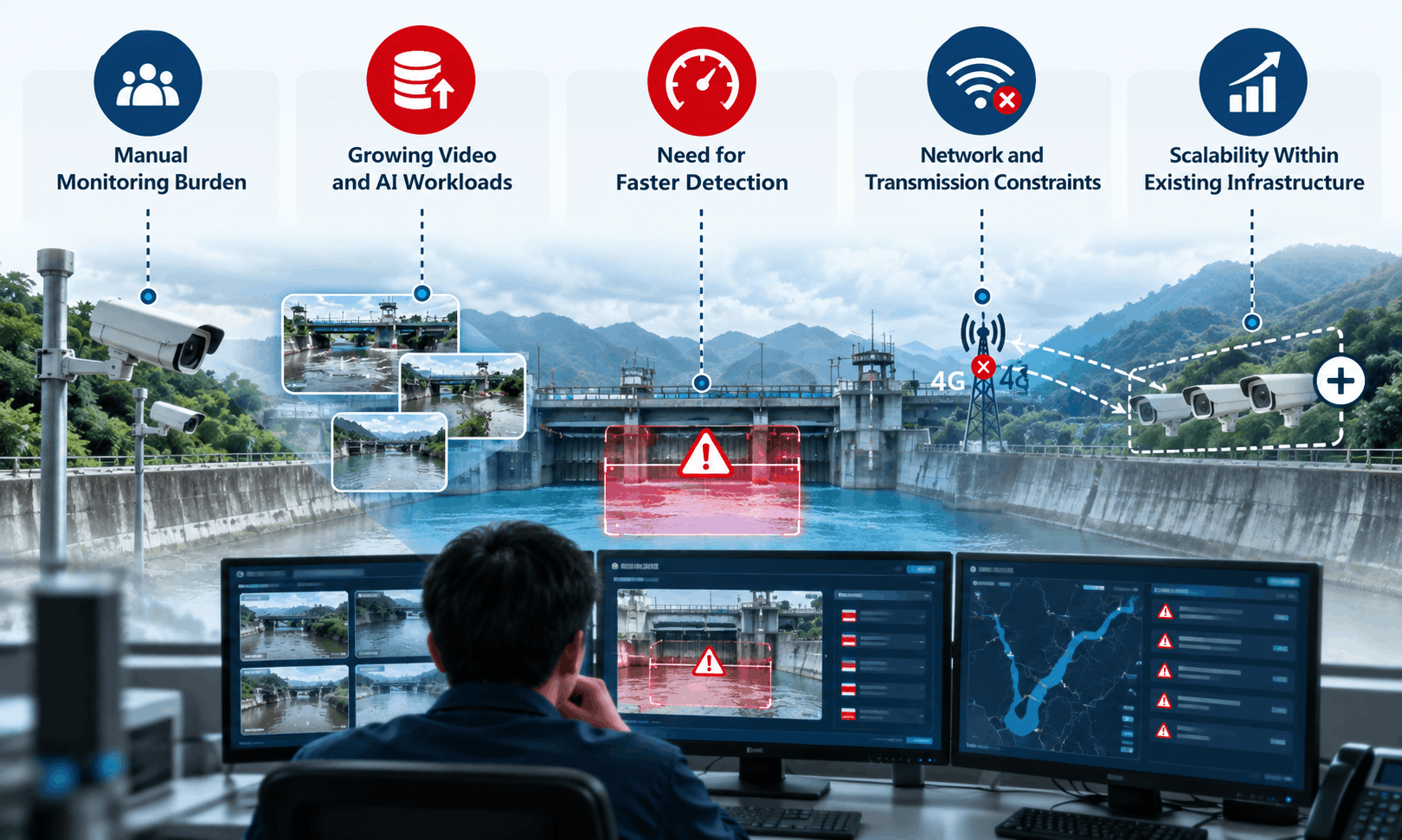
- Labor-Intensive Visual Monitoring: Operators must review multiple camera feeds and interpret changing water conditions. During heavy rainfall and typhoons, increasing video volumes can intensify the monitoring burden and make it more difficult to identify critical events promptly.
- Centralized Processing Bottlenecks: Concentrating video streams and AI workloads at central facilities increases demand for computing resources as camera networks expand and concurrent analysis tasks multiply. Time-sensitive events can benefit from faster local analysis rather than relying entirely on centralized inference.
- Time-Sensitive Event Detection: Minute-level monitoring can support routine observation, but rapidly rising water levels and emerging flood hazards require more frequent analysis. Operators need timely event identification and notifications rather than having to wait for the next monitoring interval.
- Network and Data Transmission Demands: Continuously transmitting video for centralized analysis consumes network bandwidth and processing resources. Local AI inference can reduce reliance on centralized processing for initial recognition, while allowing relevant event information and supporting evidence to be shared with the central platform.
- Scalability Without Disrupting Existing Systems: Expanding AI capabilities should not require replacing the established water management platform. The solution needs to add computing capacity where it is most valuable while preserving existing data management, monitoring interfaces, and notification workflows.
The objective at Yuanshanzi was to complement the existing centralized architecture with edge AI computing, automate time-sensitive image analysis, and accelerate event recognition and notification without replacing the established water management infrastructure.
Solution
Edge AI Computing to Reduce Centralized Processing Bottlenecks
ASRock Industrial collaborated with Focus Intelligence Technology (FIT) to deploy an edge AI-powered water monitoring solution at Taiwan’s Yuanshanzi Flood Diversion Channel. To address the growing demands of centralized video processing, the solution adds local AI computing capacity through ASRock Industrial’s AI BOX-A395 platform, bringing video analysis closer to its source while retaining the existing centralized water management infrastructure. Powered by the AMD Ryzen™ AI Max+ 395 processor, AI BOX-A395 supports local video processing, AI inference, and event evaluation. Its CPU, GPU, and NPU architecture, combined with up to 128GB of unified memory and up to 126 TOPS of overall AI performance, provides computing resources for continuous video streams and concurrent AI workloads. By distributing AI processing closer to the cameras, the solution reduces reliance on centralized inference for time-sensitive analysis and provides a scalable way to expand computing capacity as monitoring demands grow.
AI-Powered Water Recognition and Second-Level Event Detection
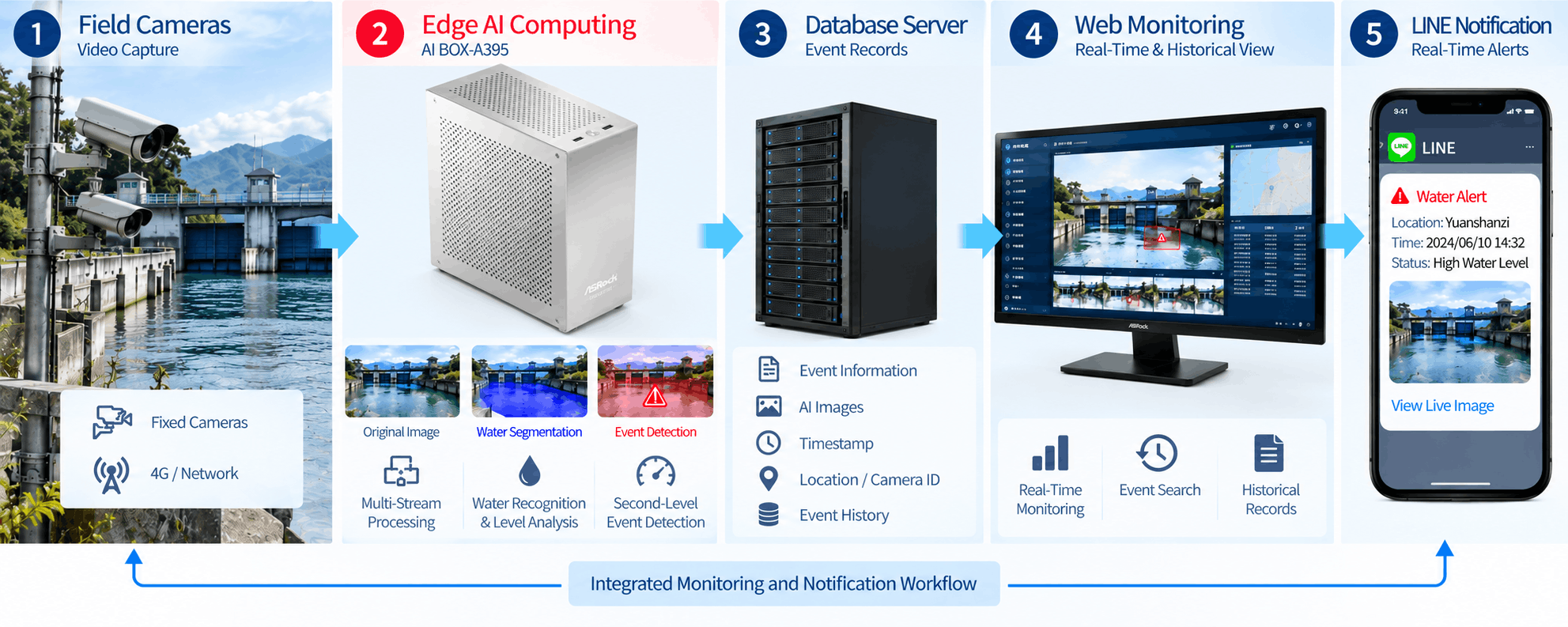
To reduce the burden of manual monitoring and accelerate the identification of critical water conditions, the solution uses AI-based image segmentation to identify water surfaces and generate water masks within camera images. By comparing detected water boundaries against predefined regions of interest (ROIs) and reference markers, the application estimates water levels and tracks changes in water coverage. Consecutive-frame analysis and configurable thresholds help determine whether detected conditions persist before classifying events as Normal, Watch, or Alert. This automated evaluation helps operators identify potentially significant changes without relying solely on continuous visual inspection, while helping distinguish meaningful water level changes from transient visual variations caused by reflections, lighting, or moving water. Running the recognition and event evaluation workflow on AI BOX-A395 enables local analysis closer to the video source. The completed proof of concept (PoC) demonstrated a shift from minute-level recognition to second-level processing, supporting faster identification of changing water conditions and more timely event notifications.
Integrated Event Management with Reduced Network Dependence
To address network transmission demands and preserve existing operational workflows, AI-generated results are integrated with the database server and web-based monitoring platform, creating structured event records that include camera location, timestamp, estimated water level, event classification, and supporting AI-generated images. Rather than requiring every video analysis task to depend on centralized inference, the solution enables local AI processing while making relevant event information and supporting evidence available to the central platform. Through the monitoring interface, operators can review current conditions, access historical records, and examine visual evidence. The solution also integrates LINE notifications to deliver configured alerts and relevant event information to personnel for follow-up.
The PoC evaluated key operational aspects, including AI server availability, database write success, web and LINE notification delivery, and stability during extended operation. By adding an edge AI layer to the established architecture, the solution expands local processing capabilities while preserving existing data management, monitoring, and notification workflows—without requiring a complete replacement of the water management infrastructure.
Benefits
- From Manual Monitoring to AI-Assisted Surveillance: AI-powered image analysis automates water surface recognition and event evaluation, reducing reliance on continuous manual review and helping operators focus on conditions that may require further investigation.
- From Minute-Level Recognition to Second-Level Processing: The completed Yuanshanzi PoC demonstrated second-level processing with edge AI computing, enabling faster recognition of changing water conditions and supporting more timely event notifications.
- Faster Local Analysis with Reduced Reliance on Centralized Inference: By processing video near its source, AI BOX-A395 provides dedicated computing resources for time-sensitive analysis, reducing the need to route every analysis task through centralized infrastructure.
- Integrated Event Management and Notifications: AI-generated event information can be recorded, visualized, and shared through the existing database, web-based monitoring platform, and LINE notification workflow, connecting image recognition with operational follow-up.
- Scalable Enhancement of Existing Water Monitoring Infrastructure: The edge AI layer complements the established centralized platform, allowing AI processing capacity to be added where needed while preserving existing data management and monitoring workflows.
Releated Product