2026-02-23 [Case Study] Texas A&M Deploys AI Nuclear Control Powered by COPA 500 and ASRock Industrial Systems
Introduction
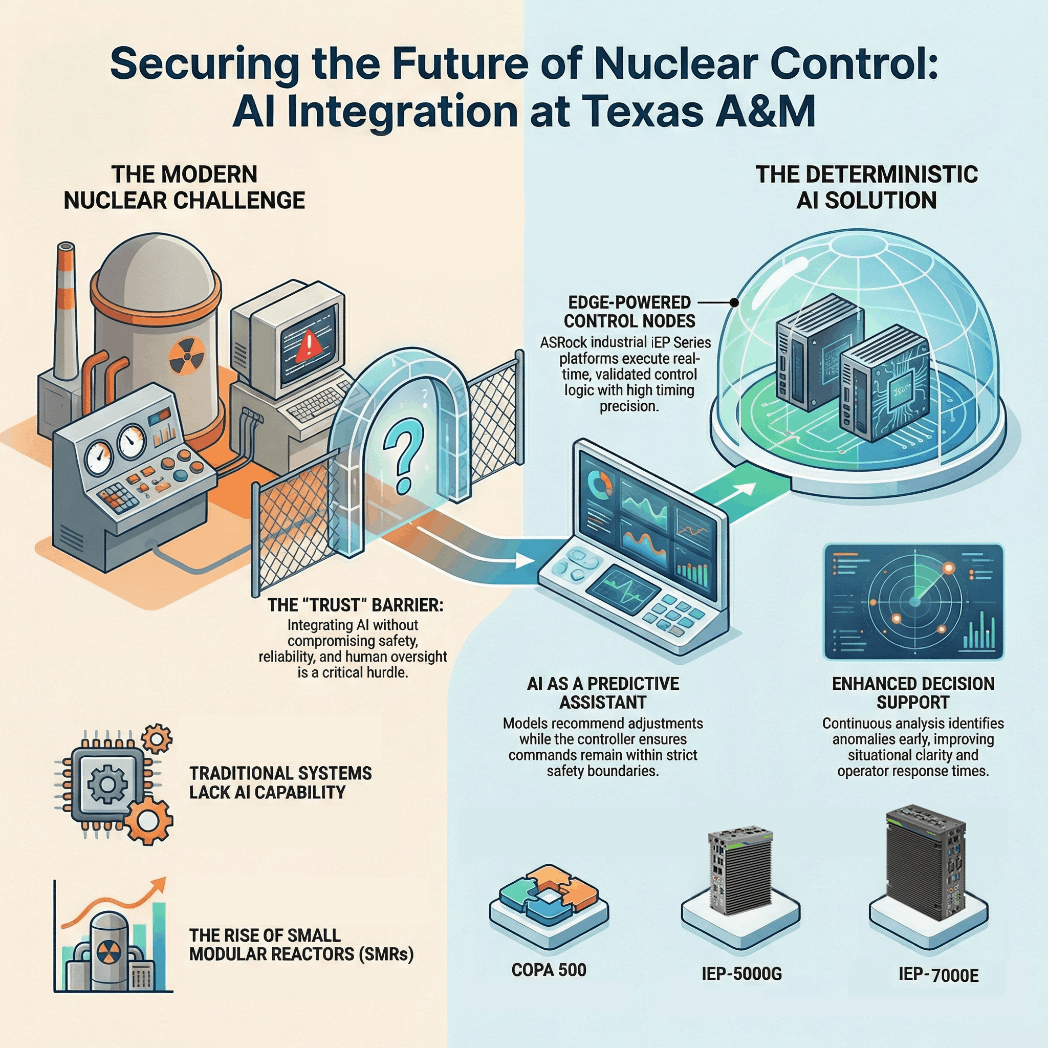
In response to growing global demand for reliable and resilient energy systems, Texas A&M deployed a COPA 500 based AI nuclear control system integrated with ASRock Industrial’s iEP-5000G/iEP-7000E Series platforms as Distributed Control Nodes (DCNs) for real time execution and validation. Powered by deterministic edge processing, the system enables secure coordination between predictive AI models and physical reactor controls, delivering precise timing, operational reliability, and safe real-time monitoring for advanced nuclear research environments.


Challenges
Nuclear control has always focused on predictable behavior and human oversight to prevent failures in high-stakes situations. These systems are very reliable, but they weren’t designed to handle modern computational tasks like advanced analytics or AI. With global energy demand on the rise, Small Modular Reactors (SMRs) are becoming an attractive, flexible option for nuclear power. As AI starts being used to improve operations, a crucial question comes up at Texas A&M University: Can AI be integrated into nuclear control systems in a way that enhances performance without compromising safety, reliability, and trust? The challenge is building a control system that can handle real-time, AI-assisted operation in a physical nuclear facility—a level of capability that traditional nuclear control systems just weren’t built for.
Solution
To address this challenges, Texas A&M implemented the COPA 500 open control platform and deployed ASRock Industrial’s iEP-5000G/iEP-7000E Series as Distributed Control Nodes (DCN) responsible for the AI-assisted nuclear control architecture. By using the proven automation components in the COPA 500 ecosystem, Texas A&M was able to blend traditional industrial reliability with modern computing flexibility. This combination made it possible to safely monitor systems remotely, keep a close eye on data, and tightly align AI predictions with actual control actions.
Acting as the deterministic processing layer of the system, the platform continuously collects sensor data, evaluates operating conditions, and executes validated control logic with predictable timing precision. Within this framework, AI models function as predictive assistants that analyze reactor behavior and recommend adjustments, while the edge controller ensures all commands remain within predefined safety boundaries before being applied to physical systems. This architecture enables advanced intelligence to be introduced into reactor environments without compromising reliability, allowing secure real-time monitoring and control while preserving the stringent operational discipline required in nuclear engineering.
Learn more about COPA 500 at copacontrol.com.
Benefits
• Real-Time AI-Assisted Operational Insight
The system applies AI models to continuously analyze reactor conditions, identify anomalies, and issue early notifications. This approach strengthens decision support by improving response time and situational clarity while maintaining operator authority.
• Persistent Monitoring and Controlled Operation
System integration enables ongoing supervision of operational data, ensuring conditions are consistently tracked and managed. This level of continuous oversight is essential for maintaining stability in nuclear research environments.
• Industrial-Grade System Reliability
The control architecture demonstrated dependable performance from initial deployment, meeting the reliability standards required for high-integrity and safety-critical applications.
Related Product