2026-02-02 Accelerate Your EU CRA Readiness with ASRock Industrial’s Secure Edge AI Platform
Introduction
As digital transformation accelerates across manufacturing, retail, healthcare, and critical infrastructure, edge computing has become a foundational layer of modern operations. Devices deployed at the edge now process sensitive data, control physical systems, and enable real-time decision making, bringing unprecedented efficiency while also expanding cybersecurity risk. To address these growing threats, the European Union has introduced the EU Cyber Resilience Act (EU CRA), fundamentally redefining cybersecurity expectations for products with digital elements sold in the EU market. Under the CRA, cybersecurity is no longer an optional feature or post-deployment add on, it becomes a baseline requirement by design, enforced across the entire product lifecycle.
Cybersecurity Risks and Losses in Edge Computing
Edge devices are often deployed in distributed, unattended, or resource constrained environments, making them particularly vulnerable to cyber threats such as unauthorized access, malware injection, supply-chain attacks, and lateral movement across networks. Real-world incidents such as NotPetya, the Colonial Pipeline attack, and TRITON malware demonstrated how unpatched systems and insecure endpoints could be rapidly exploited at scale. This attacks disrupt manufacturing operations, energy supply, and critical infrastructure, leading to production downtime, financial losses, regulatory penalties, and long-term reputational damage.
As edge computing continues to scale, these risks multiply, making cybersecurity a business-critical and operational priority. To address this, the EU Cyber Resilience Act enforces mandatory security standards, ensuring devices entering the EU market meet strict requirements from day one.
What Is the EU Cyber Resilience Act and Why Act Now?
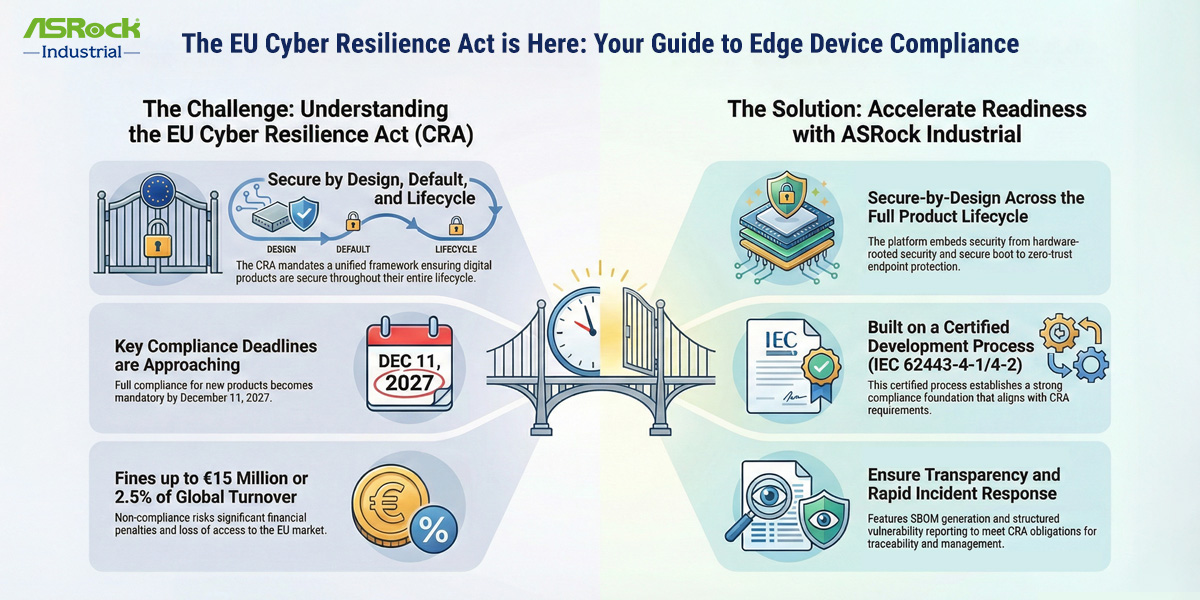
The EU Cyber Resilience Act establishes a unified cybersecurity framework for products with digital elements sold in the European Union. Its goal is simple but far-reaching: ensure that digital products are secure by design, secure by default, and secure throughout their lifecycle.
The CRA officially enters into force on 12 December, 2024. Active vulnerability and incident reporting obligations begin on 11 September, 2026, and full compliance for new products becomes mandatory by 11 December, 2027.
Why act now?
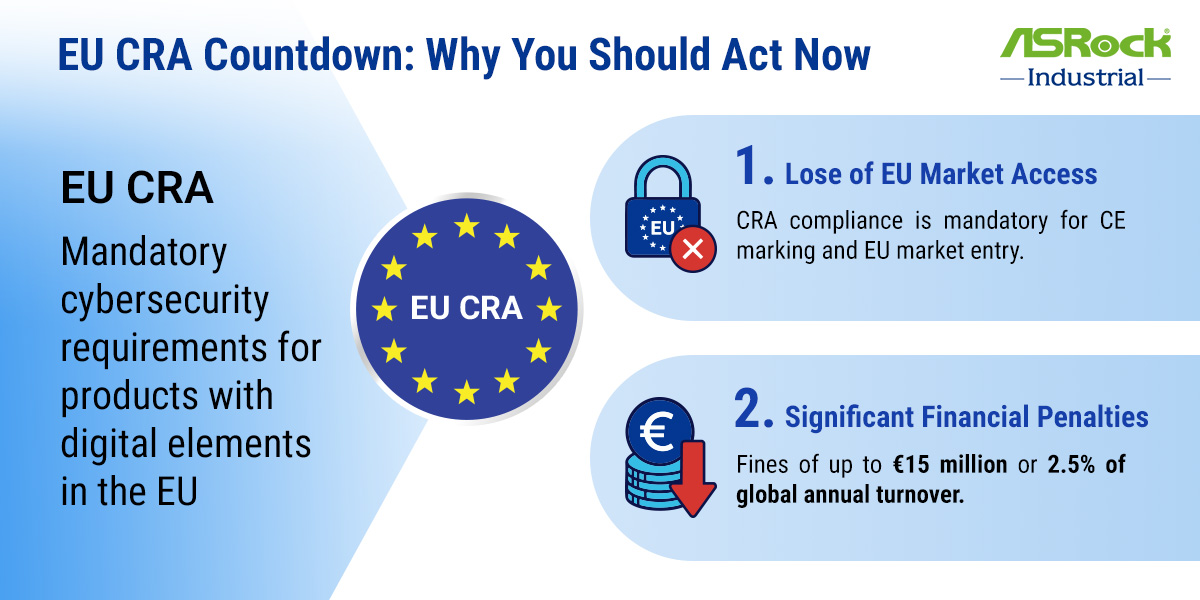
- Market access: CRA compliance is essential for CE marking and continued access to the EU market.
- Financial risk: Non-compliance can result in fines of up to €15 million or 2.5% of global annual turnover.
- Operational readiness: CRA compliance requires structural changes in product design, development, deployment, and maintenance, changes that cannot be implemented overnight.
For organizations developing or deploying edge AI systems, CRA readiness is no longer a future consideration. It is a strategic decision that must be made now.
Enterprise Responsibility: Compliance Starts with the Right Partner
Under the EU CRA, manufacturers, importers, distributors, and sellers are responsible for:
- Designing and producing products with secure-by-design principles
- Implementing vulnerabilities management and providing timely security updates throughout the product lifecycle
- Reporting actively exploited vulnerabilities and cybersecurity incidents within mandatory timelines
Meeting these obligations requires more than individual security features. It demands an end-to-end cybersecurity approach, spanning hardware, software, deployment, monitoring, and incident response.
As a result, choosing the right platform and solution partner becomes a critical compliance decision. Enterprises must work with vendors who understand regulatory requirements, embed security into their development processes, and can support long-term compliance across evolving threat landscapes.
Accelerating EU CRA Readiness with ASRock Industrial’s Secure Edge AI Platform
ASRock Industrial addresses EU CRA requirements through its Secure Edge AI Platform, designed to help customers accelerate compliance, maintain leadership in regulated markets, and unlock new business opportunities.
Secure by Design Across the Product Lifecycle
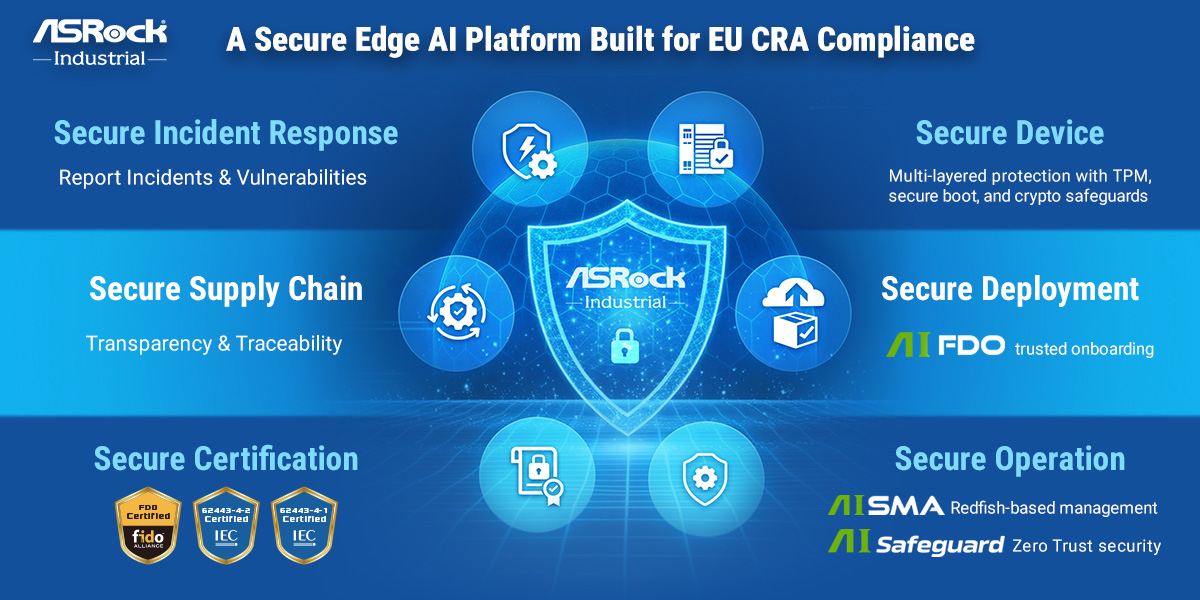
ASRock Industrial delivers a comprehensive security platform covering devices, deployment, and operations. From hardware-rooted security and secure boot to trusted onboarding and zero-trust endpoint protection, the platform embeds cybersecurity across the full product lifecycle, helps customers meet EU CRA secure-by-design expectations.
IEC 62443-4-1/4-2 Certified Development Process
Security is built into the development process through internationally recognized standards. ASRock Industrial has obtained IEC 62443-4-1/4-2 certification, implementing certified secure development workflows and verification mechanisms. This certified development process establishes a strong compliance foundation that supports EU CRA requirements and future regulatory alignment.
Transparency, Incident Response, and Supply-Chain Trust
When security incidents occur, visibility and speed are critical. ASRock Industrial supports:
- SBOM generation to ensure supply-chain transparency
- Structured vulnerability disclosure and reporting mechanisms
- Rapid incident response and remediation capabilities
These capabilities directly support CRA obligations for vulnerability management, incident reporting, and traceability.
Conclusion: Turning Regulation into Competitive Advantage
The EU Cyber Resilience Act marks a turning point for the digital product market. Cybersecurity is no longer a differentiator, it is a prerequisite. For organizations operating at the edge, CRA compliance represents both a challenge and an opportunity.
By adopting secure-by-design platforms and partnering with experienced solution providers, enterprises can not only meet regulatory requirements, but also strengthen trust, reduce operational risk, and future-proof their edge AI deployments.
Secure your edge. Stay compliant. Lead with confidence.
Contact us to learn how our Secure Edge AI Platform can help you navigate EU CRA compliance and build resilient, future-ready solutions.